
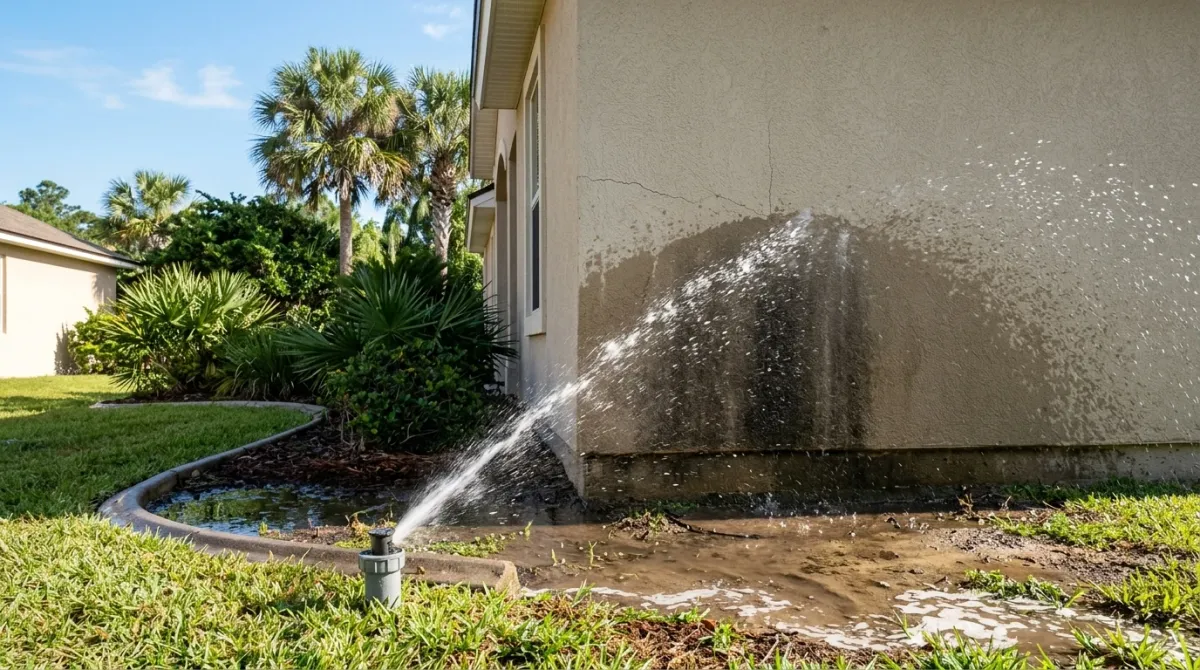
Your sprinklers help keep your lawn green. But one broken sprinkler head can quietly hurt the home foundation it sits next to. In Jacksonville and across Northeast Florida, the soil shifts a lot. Sandy soil and clay soil swell when wet and shrink when dry. When a faulty irrigation system leaks water in the same spot for weeks, the soil moves. Your slab moves with it. Costly foundation problems can start with one broken spray head.
This guide shows how sprinkler-related issues cause water to wreck your home, the warning signs to watch for, and how to prevent costly future damage.
The path from a faulty sprinkler to a cracked slab is short. Excess water pools near the foundation. The soil surrounding your home gets soaked. Then it dries. Then it gets soaked again. This cycle pushes and pulls on the slab. Over time, you see cracks in the foundation walls, drywall, and tile.
In Florida, this is worse than in dry states. Our clay soil is expansive. It swells when saturated. It shrinks when the sun bakes it dry. The bigger the swing, the more pressure on the slab. That can cause foundation movement and uneven settling.
"Most foundation calls we see in Ponte Vedra Beach started with a sprinkler problem nobody fixed. The leak ran for months before the cracks showed up." Joel Moss, Sawgrass Construction Solutions
Most sprinkler-related damage starts underground. A cracked pipe, a leaking valve, or a stuck spray head can drip water into the soil 24/7. The leak goes unnoticed for weeks. By the time you spot wet grass or a higher water bill, the damage is done.
Common ways water can cause foundation issues:
Each one of these can cause water buildup that turns into structural damage.
Florida soil is a mix of sand, clay, and topsoil. The clay layer holds water like a sponge. Too much water in the same spot, day after day, causes the clay to swell. Hot sun then makes it shrink. Repeat this cycle next to a slab and the slab cracks.
Overwatering does not just kill grass. Excess water near the foundation builds hydrostatic pressure against the slab and footings. This pushes outward, leading to cracks in foundation walls. Homes with a crawlspace or basement feel this even more, since water can pool below the floor and create damp instability.
Most homeowners often miss these signs early. They blame the home's age or normal settling. The real cause is a faulty irrigation system soaking the soil month after month.
| Warning Sign | What It May Mean |
|---|---|
| Drywall cracks above doors | Foundation movement from wet/dry soil |
| Sticky doors and windows | Slab tilt or uneven settling |
| Stain along the perimeter | Water pooling near the foundation |
| Mold in crawlspace or basement | Excess water saturating wood and stain |
| Uneven floors | Soil moisture pulling one side down |
| Wet siding or stucco | Spray hitting the side of the house |
| Water stain on landscape mulch | Spray head misaimed at landscape beds |
Most Jacksonville homes are built on a slab. Some older homes, like those in St. Augustine, sit on a crawlspace. A few homes in the area have a partial basement. Each one reacts in its own way to water.
On a slab home, you see cracks in the concrete, tile, or drywall. Doors get tight. Floors slope. On crawlspace homes, you may smell mildew. Wood beams swell or rot. In rare basement homes, water seeps in along the foundation walls. Either way, the damage starts with water from a sprinkler that no one fixed.
A drip from a leaking valve might seem harmless. But over weeks, it adds up to hundreds of gallons. A misaimed spray head can do the same in a day. Both can push water flow toward the house instead of away from the house. Good grading and drainage help, but they cannot fight a leak that runs every cycle.
We see this often in homes where the irrigation system was installed too close to the slab. The position of the head matters. So does its angle. A small adjustment can mean the difference between a healthy lawn and a cracked slab.
Don't wait if you see cracks, stains, or wet spots near the foundation. The longer water sits there, the bigger the repair bill. Start with a simple inspection.
Call a leak detection technician to:
A short visit can save thousands in structural repair down the road.
Prevention is cheaper than repair. To avoid costly damage and prevent costly future cracks:
These small steps keep soil stable, which is what your slab needs.
Sawgrass Construction Solutions Leak Detection has 40+ years of construction and leak experience. We work on irrigation, pool, slab, plumbing, and water systems. Our crews find leaks others miss because we know how broken sprinkler heads connect to structural problems around homes.
Most companies stop at finding the leak. We go further. We document where water has been pooling near the foundation. We measure soil moisture levels. You get a written report you can share with your foundation contractor or insurance company.
Our process for sprinkler-related foundation calls:
Most leak detection companies handle one or two systems. We cover all of them. Pool, plumbing, slab, irrigation, and water heaters fall under one team. That means we never have to call a second contractor when the leak turns out to be in a system you did not expect.
We serve Jacksonville, Ponte Vedra Beach, St. Augustine, Atlantic Beach, Jacksonville Beach, Neptune Beach, Fleming Island, Orange Park, Middleburg, Green Cove Springs, Fruit Cove, Palm Valley, Sawgrass, West Augustine, and World Golf Village. Local crews. Licensed work. Clear pricing. Real results.
If you suspect your sprinkler system is causing foundation issues, schedule a leak detection visit today. Don't wait for the cracks to spread. We respond fast across Duval, St Johns, and Clay counties.
Call Sawgrass Construction Solutions Leak Detection at (904) 815-1263 to schedule expert irrigation leak detection. We serve Jacksonville and all of Northeast Florida.
Need Leak Detection Help?
(904) 815-1263Our team is ready to diagnose and fix the issue. Call now or send us a message — we'll get back to you fast.
Contact UsSchedule a leak detection or call us for immediate assistance