
Your pool is losing water, and you've spotted a crack in the shell. Is the crack causing the leak, or is the leak somewhere else entirely?
Each year, confusion between pool leaks and structural cracks leads many Jacksonville homeowners toward the wrong repair. At Sawgrass Construction Solutions Leak Detection, we answer this exact question for customers throughout Northeast Florida.
Here's how to tell the difference before spending money on the wrong repair.
A leak and a structural crack are not the same problem, even though they often show up together. Fixing one does not automatically fix the other.
Some cracks are cosmetic and have no connection to water loss. Others may be the actual source of the leak. Misdiagnosing the issue can be costly: you may pay for leak detection that finds no problem, or patch a crack that was never leaking.
Not every crack means trouble. Cosmetic cracks form in the plaster or gunite surface layer, usually from normal curing or minor settling.
Structural cracks extend deeper through the pool shell and are more likely to cause water loss. The distinction is important because a cosmetic crack may require only a simple patch, while a structural issue requires proper diagnosis before any repair begins.
Keep in mind that appearance alone is never enough to diagnose a pool leak. Some structural cracks never leak, while some small hairline cracks do. Proper testing is the only way to know for sure.
A cosmetic crack is usually thin, hairline, and does not widen over time. It also tends to follow a somewhat random pattern across the surface.
A structural crack often runs in a straighter line. It may widen gradually and sometimes appear alongside other warning signs like shifting tile or an uneven deck edge nearby.
This is where the issue can become especially confusing for homeowners. A visible crack does not necessarily mean that crack is the source of water loss.
If water loss continues after a temporary patch, the crack is likely not the source. In that case, the issue may involve plumbing, the skimmer, or a light fixture instead.
In other cases, certain signs may point directly to the crack as the source of the leak.
Air bubbles appearing near the crack during normal filtration are a strong indicator. Water loss that slows significantly when the pump is off can also be a warning sign. Pressure from a running pump may force water through a structural crack faster than it would escape otherwise.
A crack that is actively leaking usually shows some combination of these signs together, not just one. Isolated evidence rarely tells the full story.
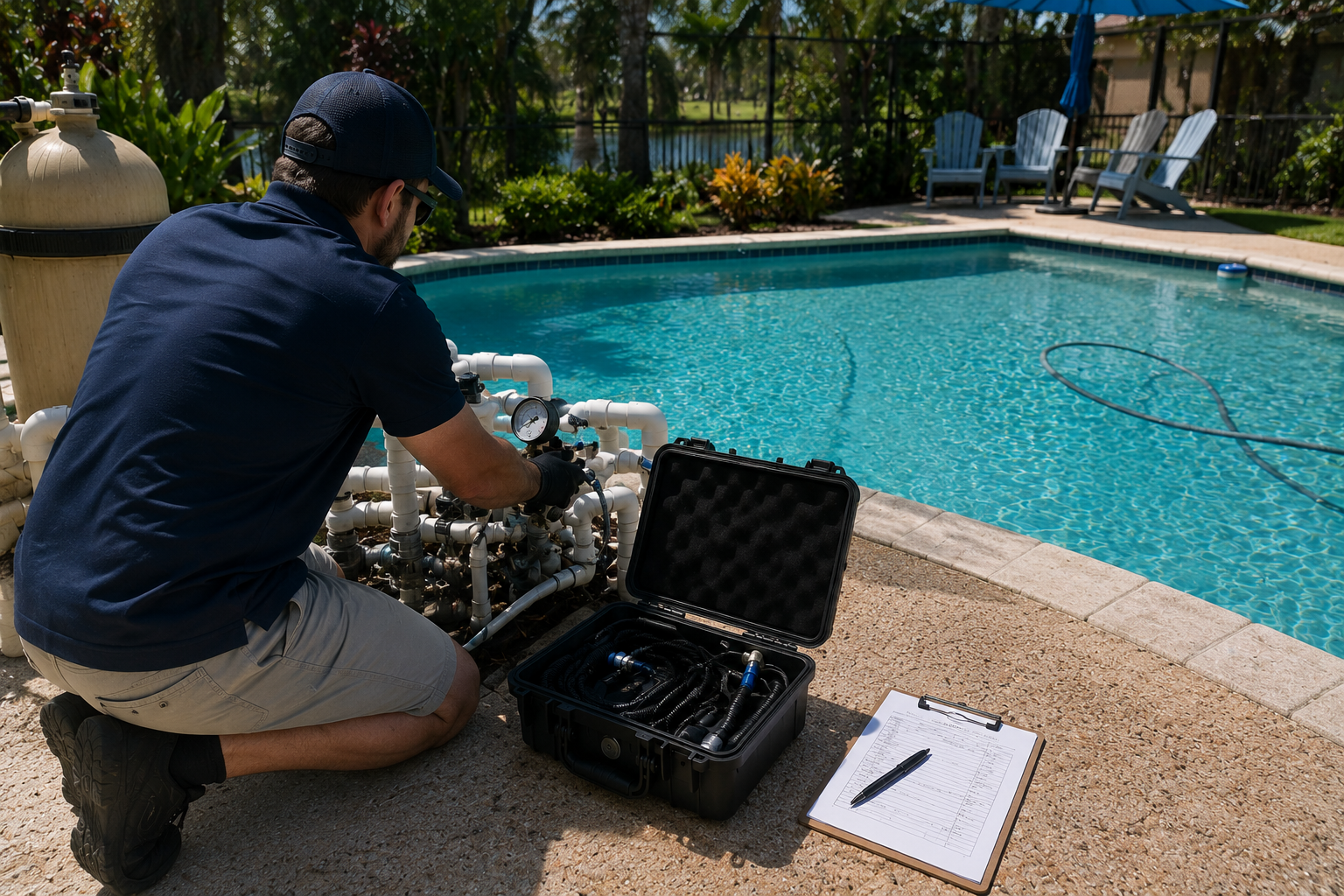
When we arrive at a Jacksonville property with this concern, we do not guess. We begin by pressure testing the plumbing lines separately from the pool shell.
This helps determine whether the water loss comes from underground pipes or from the pool structure itself. If a crack is visible, dye testing may follow. Dye drawn toward a crack under water pressure confirms active leaking in a way visual inspection alone cannot.
Older Jacksonville pools built before the mid-1990s often have plumbing runs positioned differently than modern pools. In more than one case, we have found leaks six to eight feet away from a visible crack. The crack appeared to be the obvious cause, but the plumbing had not been checked first.
Our region’s sandy soil shifts more than the clay-based soil found farther inland. That movement is a major contributor to structural cracking in older pools and can worsen after the heavy rain events common during hurricane season.
Many Jacksonville neighborhoods also sit close to the water table. As a result, ground movement around a pool shell can be more common here than in drier parts of the state. This is one reason the same type of crack may remain cosmetic in one yard but become structural in another. The soil composition beneath the pool often plays a larger role than homeowners realize.
A structural crack that goes untreated typically worsens over time. As water escapes through the crack, it can erode the soil beneath the shell. That erosion may lead to additional settling and a wider crack later.
This can create a costly cycle: water loss causes soil erosion, erosion leads to shifting, and shifting can make the crack larger. Addressing the issue early helps stop that cycle before it becomes a major structural repair.
A homeowner in Mandarin contacted us because they believed their pool had a major structural issue. Another company had already provided a quote for a full shell repair based on a crack near the deep end.
We performed a pressure test on the plumbing before addressing the crack. The actual leak was a failed return jet fitting, completely unrelated to the crack the homeowner had been watching for weeks. The visible crack was cosmetic, likely dating back to the original construction, and had no connection to the water loss.
That repair cost a fraction of the earlier quote. Situations like this are common enough that we always start with testing before assuming the most visible issue is the true source of the leak.
Not every crack or water-loss situation requires immediate service. Knowing the difference can help you avoid unnecessary stress and unnecessary rush fees.
Call right away if you notice rapid water loss—more than two inches in a single day—along with a visible crack that appears to be growing. That combination may indicate active structural movement that could worsen quickly.
You can typically wait a few days to schedule an inspection if water loss is slow and gradual, and any visible cracks appear stable and unchanged. Slow, steady issues rarely become emergencies overnight.
A cosmetic crack patch typically costs a few hundred dollars and takes less than a day. By contrast, a structural crack repair can cost several thousand dollars depending on severity, especially if it requires underlayment work or partial shell reconstruction.
That difference is why proper diagnosis is so important before committing to any repair. Paying for accurate testing once is usually far less expensive than paying for the wrong repair twice.
A typical inspection takes one to two hours on site, depending on pool size and the number of potential leak points that need testing. We walk homeowners through each step instead of simply delivering a conclusion at the end.
Many Jacksonville homeowners are surprised by how much of the process is visible and easy to understand. That transparency is important, especially when a homeowner is deciding whether to invest in repairs.
Look for air bubbles near the crack during normal filtration and monitor whether water loss slows significantly when the pump is turned off. A professional dye test near the crack under water pressure provides the most reliable confirmation.
Sometimes, but not always. Hairline cracks are often cosmetic and unrelated to leaking. A crack that has widened or runs through the shell structurally is far more likely to be the actual source of water loss.
Some surface cracking is common due to normal curing and the region’s shifting sandy soil. However, cracks that widen, run in straight structural lines, or appear alongside shifting tile should be inspected professionally. They should not be dismissed as normal wear.
This usually means the leak is located at that specific height, often at a skimmer, light fixture, or fitting rather than in the pool shell itself. Once the water level drops below the leak point, water loss naturally stops until the pool is refilled.
We generally do not recommend it. A DIY patch can temporarily mask an active leak, making it harder for a technician to accurately test and identify the true source once professional help is requested.
Costs vary based on pool size and the complexity of testing required. Even so, most standard inspections cost less than guessing wrong and paying for an unnecessary repair. We provide a clear estimate before any test begins.
If you see both a crack and a dropping water level, do not guess which one caused the other. Schedule a consultation with Sawgrass Construction Solutions Leak Detection. We will identify exactly what is happening before you spend money on repairs.
Need Leak Detection Help?
(904) 815-1263Our team is ready to diagnose and fix the issue. Call now or send us a message — we'll get back to you fast.
Contact UsSchedule a leak detection or call us for immediate assistance